
The Official Anthem of MeToo’s RevivalOct 23
the cornell 7 and lindsay clancy cases have sparked a resurgence of online female empowerment. in paris paloma’s ‘labour,’ these women have found their new slave song
54 Likes
12 Comments
Oct 25, 2026

Starting on September 28, 2026, Peter Thiel gave a series of four off-the-record lectures about the Antichrist. These were held in Nashville at the Grand Lodge of Tennessee Free and Accepted Masons on four consecutive Mondays.
I was fortunate enough to attend each of these lectures, and more fortunate yet to be permitted to write about their contents. Thiel has given versions of these talks previously, also off the record, in San Francisco and Rome. As I did not break the rules by sneaking in a recording device, the below is my best attempt at a faithful reconstruction of the events and arguments from my memory, notes, and occasional reference to online posts from other attendees.
I parked several minutes’ walk from the Masonic lodge, arriving half an hour before the event’s 6 p.m. posted start time. As I approached, it became clear that this was insufficient: winding down from the metal detectors situated atop the pillared building’s stone stairs, and past multiple security guards and a pacing K-9 team, was a line of people so long that it turned the street corner and continued on for multiple blocks. I walked sheepishly to its caboose.
The crowd was largely male and suit-wearing, not in a formal or businessy way, but rather in a tieless or two-buttons-undone way. I expected to see a larger presence of bespectacled, bed-headed techy types, but in their stead found throngs of guys who were much conventionally cooler than I was and were likely cigar puffers or raw-egg slonkers.
There were a lot of young men who looked plucked out of a College Republicans club, but there were also perhaps a few more women, old and young, than one would have expected to see at the event. As we collectively snaked our way up to the front for ID checks, the sidewalk and adjacent buildings’ wall nooks became increasingly strewn with notebooks and pens. Apparently, a message had been passed down that note taking would not be permitted. The flat top of some truncated pillar nearest to the security entrance was littered with several dozen short-cylindrical Zyn tins, as it turned out that these were also prohibited. It was not particularly surprising to me that this crowd, as a demographic, would be packing heavy Zyn artillery. Both prohibitions (notebooks, Zyns) were later lifted by the organizers, citing overzealous security, meaning that I was able to take written notes for three of the four lectures I attended.
The theater was large and somewhat traditional, with raked red velvet seating. Space in the center, in front of the stage, was rowed with pew-like wooden benches and roped off for VIPs. Each session was to have a roughly two-hour format: a one-hour lecture followed by an hour-long Q&A moderated by Peter Robinson, a Hoover Institution fellow (and host of the popular Uncommon Knowledge podcast) who penned Reagan’s famous “Mr. Gorbachev, tear down this wall!” speech.
Peter Thiel came out from stage left. His lecture slides were displayed behind him on an extremely large, blindingly bright screen that was maybe twelve feet tall and covered the entire width of the stage. The slides were simple in design: white backgrounds and blue text. He settled at the podium and began.
Author’s note: Peter Thiel and Sam Wolfe have co-authored two excellent essays, “Voyages to the End of the World” (October 2025) and “The Pope and the Antichrist” (July 2026), which overlap with certain elements of the Antichrist lectures. I recommend reading each in its entirety.
The Christianity of these lectures is central; they are necessarily Christian and rely heavily on Biblical descriptions of the end of history and the signs that herald its coming. Thiel says that he modeled them after John Henry Newman’s four-part 1835 lecture series, “The Patristical Idea of Antichrist.”
In one of the Q&A sessions with Peter Robinson, Thiel — affectionately referred to throughout as the “young” Peter, relative to the boomer-generation Peter Robinson — described himself as a “small-o orthodox Christian.” When asked if he believes that Scripture is “inspired,” he responds, “yes, it should be taken seriously, though sometimes not completely literally.” Thiel emphasized that we should study and reason about the Bible, rather than follow it blindly, and notes that one will find it to have a surprising resonance with our times. In a related discussion, he emphasized that the so-called “Great Books” are much lesser than the Bible and should not be worshipped. Instead, these books should be treated as tools to understand their times and must themselves be considered through the lens of the Bible. This approach sets up the ethos for much of the following lecture series.
The Christian eschatology that Thiel draws upon tells of an apocalyptic age dominated by a deceptive ruler referred to as the Antichrist — the portrait of this ruler is one constructed through an amalgamation of biblical sources and whose shape is up to some level of ecumenical interpretation.
Revelation tells of a beast from the sea, often interpreted as the Antichrist and his associated apparatus of power, and a beast from the land, who rises from the earth to persuade humanity to worship the beast from the sea and enforces this worship under threat of death. This latter figure is viewed as a kind of ideological or religious ally to the Antichrist, a false prophet.
Satan empowers the beast from the sea to exercise authority over all peoples, languages, and nations. It wages war against the saints, and all earthly kings surrender their power to it. From this, and other earlier biblical mentions, the image of the Antichrist as a one-world totalitarian dictator emerges. If the Bible is true, or at least “inspired,” how do we end up in such a dire situation, and what can be done to delay or prevent it, if anything?
The reign of these beasts precedes a final conflict in which Christ returns victorious; the Antichrist and false prophet are cast into a lake of fire. Christ then reigns for a thousand years, during which time Satan is bound. Satan is released after this epoch, briefly rebels, and is eternally defeated. God then passes final judgment on the dead, death and hell are cast into the lake of fire, and a new heaven and earth replace the old.
Even more complicating, then, is the implication that the Antichrist’s arrival is a necessary precursor to the Second Coming of Christ and subsequent renewal of all creation. Does stopping one prevent the other? Should we even be looking to delay the end of the world? Maybe we should just accelerate, put the pedal to the floor and close our eyes and just get it all over with already.
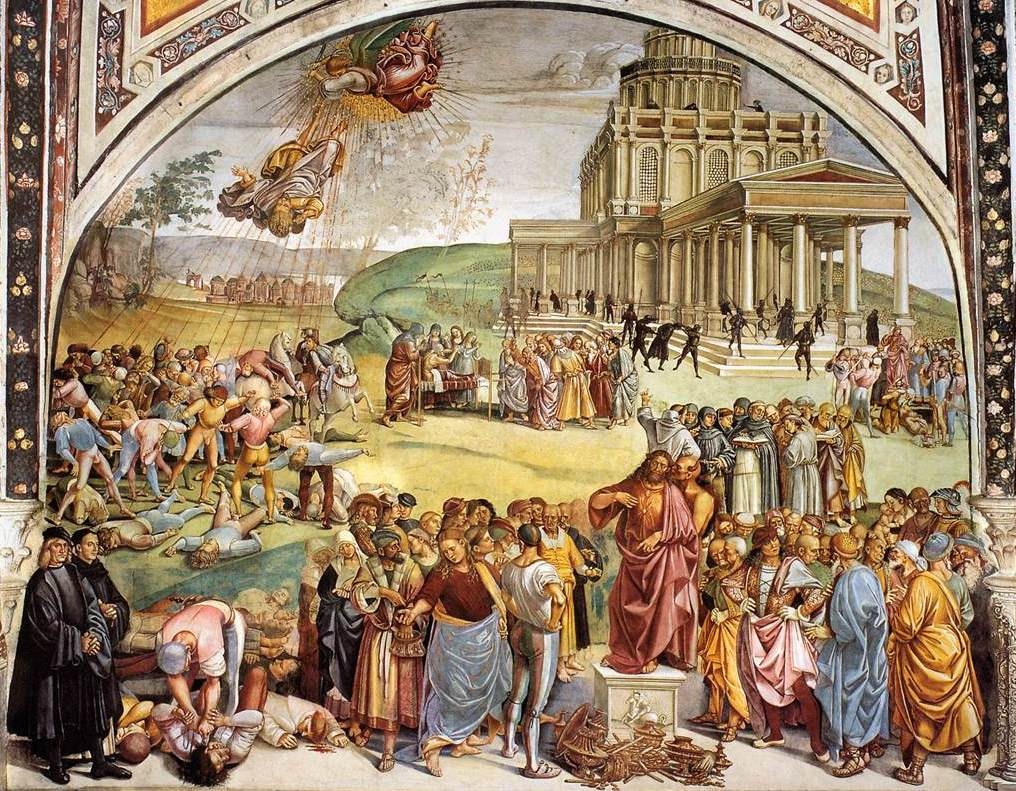
While portrayed metaphorically as the beast from the sea in Revelation’s account, the Antichrist has long been thought to manifest himself in a counterintuitively Christlike manner. Thiel featured Luca Signorelli’s “Sermon and Deeds of the Antichrist” in his lectures multiple times: It shows Satan whispering into the ear of the visually Christlike Antichrist, and the upper-left scene of the fresco depicts the Antichrist’s failed imitation of the Ascension of Christ.
To understand the arguments that Thiel sets forth, it is important to understand that the Antichrist will be somehow very much like Christ, perhaps even hyper-Christian in a perverted way, superficially co-opting the culture and moral ethic of Christianity while removing Jesus Himself from its center. Thiel cites Matthew 24:24, “For there shall arise false Christs, and false prophets, and shall shew great signs and wonders; insomuch that, if it were possible, they shall deceive the very elect.” If even “the very elect” of the Christian body may be deceived, the Antichrist must at least appear to have something in common with Christ.
A key feature of the Christian conception of history is that it is progressive, rather than cyclical. We are moving through time toward an endpoint. More than this, Christianity itself is a primary driver of that history. It is upstream of science, says Thiel, referencing French philosopher René Girard’s burgeoningly acclaimed and often shallowly represented theory of mimetic desire. The nuances of Girard’s philosophy are too difficult to crack open here, but suffice it to say that this logic involves a process of desacralization which is intertwined with the spread of Christianity and results in the deconstruction of the “scapegoating” victimage mechanism. Thiel’s simplified explanation is that when you can no longer scapegoat a witch and burn her at the stake to restore societal unity, you have to instead begin looking for natural causes. This creates a cascading effect which, in turn, means — per Thiel and Girard — that the Christian understanding of progress is upstream of the Enlightenment.
This is not an idea acknowledged only by those of Christian faith: great non-Christian thinkers have similarly recognized Christianity’s role in shaping history. Nietzsche understood that Christianity as a moral and cultural force could not be left behind, as much as he desperately wished to obviate its influence, and he realized that it was Christianity which reshaped the modern understanding of morality.
Edward Teller, the “father of the hydrogen bomb” and inspiration behind Dr. Strangelove’s character, was an agnostic of Jewish heritage. He wrote in a July 1945 letter to Leo Szilárd that he wished to leverage the power of atomic bombs in order to end war itself. One who believes that war as a concept can be ended cannot fully subscribe to a cyclical historical framework, which would instead view conflict as endlessly recurring between powers.
Thiel emphasizes that even as things get greater over time, they can grow more terrible. The 20th century was the most great and most terrible, he said, but the 21st could be “even greater and more terrible.” This is endemic to the Christian historical idea.
Given, then, that the Christian eschatological age is a potential reality rather than simply fictional invention, one might begin to wonder where we are on the timeline. Will the milk in my fridge have time to curdle? Should I empty the 401k and IRA, penalties be damned, and live while the living is free?
The end may not be quite that imminent, but Thiel does identify a series of signs that indicate we may be in, or very near to, the aforedescribed apocalyptic time. The first of these is somewhat meta-referential: the fact that we frequently talk about armageddon, but do not talk anymore about the Antichrist.
For those attuned to the culture of modernity, the prevalence of armageddon discourse is self-evident. Various groups of people proselytize their particular causes: Greta and the hyperbolic climate change people, those who think we are always on the brink of nuclear war, the effective altruists and rationalists who tell tales of misaligned artificial intelligence killing us all, those convinced of existential bioweapon and pandemic threats, and so on.
We, Christian society, have discussed and thought through the problems of the Antichrist for two thousand years. The anomaly is not that these lectures on the Antichrist are happening, but rather that such a topic is seen as strange and outside the Overton window. Thiel’s point of emphasis is not that fears of armageddon are without basis — whatever your particular catastrophic flavor of choice — but rather that there is a complicated relationship between Antichrist and armageddon, and that if everyone is talking about armageddon, we should probably think more about the threat of the Antichrist.
This leads to one of the most fundamental pieces of Peter Thiel’s thinking on this topic: the Antichrist, he says, is likely to come into power by playing on people’s fears of armageddon.
Thiel recounts Dietrich Bonhoeffer’s — a Lutheran pastor and theologian — identification of Hitler as the Antichrist and the Reich Church as spiritual accomplice. Bonhoeffer’s movement incited Claus von Stauffenberg’s July 1944 assassination attempt, in which the latter recited Stefan George’s “The Antichrist” to his co-conspirators before planting a bomb intended to kill Hitler. Thiel says that historians censor the Antichristic elements of the Bonhoeffer and von Stauffenberg events, and that this is evidence of a longer preexisting unwillingness in modernity to talk about the Antichrist. Thiel noted that we have 378 years to “catch up” on, a duration which maps to the 1648 Peace of Westphalia, an agreement that ended the Thirty Years’ War in Europe. In a 2024 conversation with Tyler Cowen about political theology, Thiel said that “these sorts of things were abandoned… one type of reason it was abandoned was because it’s too hard to figure this stuff out… I’m inclined to think the other reason was, it was often deemed as too dangerous, too divisive.” Talking about the Antichrist is perceived as dangerous not because it is ridiculous, but because it strikes some sort of underlying nerve of modernity.
the cornell 7 and lindsay clancy cases have sparked a resurgence of online female empowerment. in paris paloma’s ‘labour,’ these women have found their new slave song

the shop says kelly clarkson has put them ‘in danger,’ but everything seems pretty relaxed inside (except for all the high-strung journalists)

sydney sweeney has once again triggered the internet by showing off her curves in an ad. on the hypocrisy of these new critics, and why sweeney’s are the boobs america just can’t quit